

Zennor
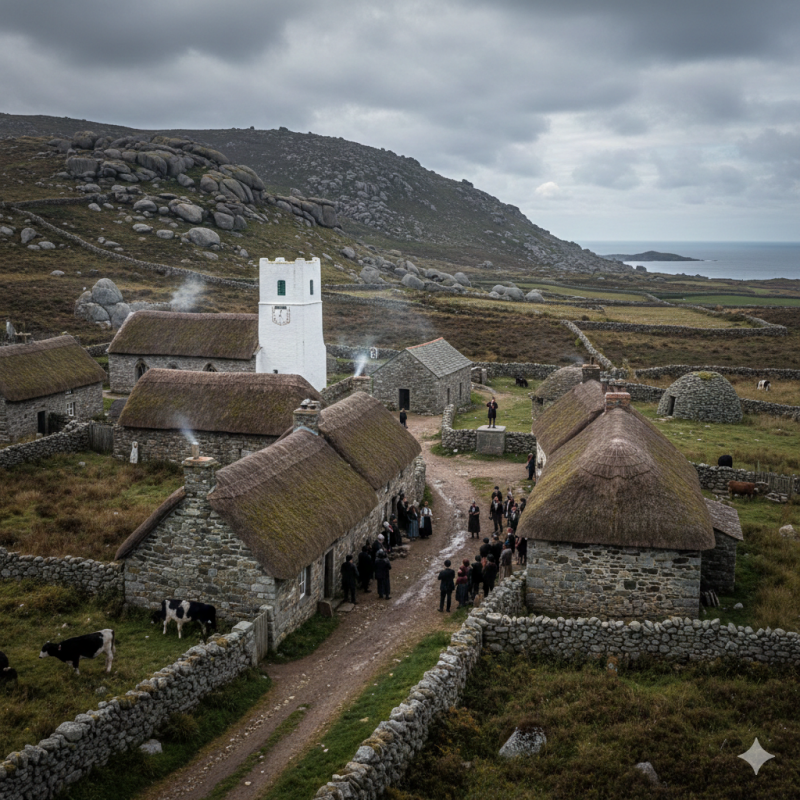

Part of Zennor parish, seen from the window of Tregeraint House, a superb place for Bed and Breakfast accommodation, with wonderful hosts - recommended!
The Berryman family
Berymans, Berrymans and Berrimans have lived in and around Zennor since at least 1550, when William Beryman ("alias Porthmeo")farmed at Porthmeor, some 2 miles down the coast from Zennor. Berrymans have lived at that same farm since that time, and still live there today. Not many families can boast such a long, unbroken occupation of their family home! It is therefore not surprising that there are still quite a few Berrymans living in the area, with very many more buried in the Zennor churchyard.
Another ancestral home of the Berrymans at Zennor was "Treveglos" ("Trev"--farmstead; and "eglos"--church: Thus, "farm of the church" or "church farm"). As a farm, "Treveglos" was known as early as 1270, but the present farm house was probably originally built in the late 1700s. The farm was once the property of a family named Treveglos; from 1384 to about 1661, it was the property of the Gerveys family, before passing to the Grylls. It is believed that Berryman families were the tenants from the 1600s to the mid-1800s. By 1872, however, it was owned by a Mr. Branwell of Penzance.
In 1841, the population of Zennor Parish was just over 1,000 people. In 1851 it was 918. There were at that time nine Berryman families and two single Berrymans (one a charwoman and the other a servant).
Most Berrymans of those times were farmers, but there was also an innkeeper. At the end of the 1800s, the population of Zennor Parish was 601, including several Berrymans, Chellews, Eddys, Hockings, Osbornes, Quicks, and Thomases, who were mostly farmers. Mrs. Hocking was a shopkeeper at Zennor Churchtown and Miss Elizabeth Berryman was the mistress of the National School (average attendance 80). John Trudgen end John Thomas were smiths. The chief landowners were the Earl of Sandwich; Caroline, Duchess of Cleveland; and Walter John Groves. Agricultural lands were devoted mostly to pasture and production of barley, oats, and wheat.
Col. "Freddie" Hirst, archaeologist and founder of the Wayside Museum, Zennor, made the following observation in the 1930s:
"In Zennor, the progenitor Adam has been replaced by Berryman, with the following result.....It is only a matter of time for all Zennor people to be called Berryman - the Vicar (1925) called everyone Berryman until corrected, and thus learned the names of his parishoners":

Local Facts
The last bastions of the Cornish language were the West Penwith parishes of Zennor, St Ives, Lelant and Towednack. John Davey (1812-1891) of Boswednack, Zennor (left) was one of the last people with a traditional knowledge of the language.
Henry Quick (1792-1857) of Zennor was a poet. A book has been written about him - "The Life and Progress of Henry Quick of Zennor" - P.A.S. Pool (Ed), 1994.
D.H.and Frieda Lawrence rented Tregerthen cottage, near Zennor.
The "Witches' Rock" at Trewa, between Nancledra and Zennor, was where the witches of Penwith are supposed to have "assembled at midnight to carry on their wicked deeds". However, anyone touching the rock nine times at midnight was insured against bad luck.
Create Your Own Website With Webador